Archive for the ‘Climbing’ Category

North Palisade: the U-Notch Couloir

Monday, July 7th, 2008

North Palisade

What an absolutely amazing adventure this was!

North Palisade offers the gamut of high alpine mountaineering challenges, from glacier travel to ice climbing to technical rock, making it not only one of the most challenging Sierra fourteeners, but also one of the most rewarding.

I had wanted to climb this route for some time, but simply didn’t have the skills or the mindset to try to solo it.

Of course I’ve also wanted to ski in the Palisades, but again I was intimidated by the terrain’s obvious technical character.

North Pal was simmering on my back burner this year when a Bishop guiding company, Sierra Mountain Guides, contacted me. That lead to my first guided trip, with North Pal being the obvious objective. The experience proved to be overwhelming positive. I learned a great deal, had a lot of fun, and got a chance to scout a number of ski descent possibilities for next year. I also got the pants scared off me (by some of the technical rock).

Let me just say a big Thanks to my guide, Neil Satterfield (who also provided additional photography for the TR), and the entire SMG crew. You can bet I’ll be back to try something like this again!

Full Trip Report here: North Pal via the U-Notch.

Off to Everest…

Wednesday, March 26th, 2008

Bishop-area guide and climber Kurt Wedberg is guiding a client up Everest via the south approach this year. You can follow their progress at the IMG Website, and also the personal blog of Kurt’s client, Michael Andrews.

This looks like a really unlucky year to be paying the usual fortune for an Everest bid. Civil war in Nepal has threatened to close off south-side access, and the Chinese government has apparently closed the entire north side of the mountain as part of an Olympics promotion stunt (they want to carry the torch to the summit). Just to add to the mix, China is reportedly pressuring Nepal to close the south side of the mountain as well. I guess they need the whole mountain to themselves for the torch ceremony?

Sounds like it will be an interested time on the world’s highest peak—but then again, it always is.

AAC Changes to Global Rescue ‘Service’

Tuesday, March 18th, 2008

The American Alpine Club has posted more information on its website about the organization’s shift from offering rescue insurance as a member benefit to a rescue ‘service’ managed by Global Rescue Worldwide.

While AAC’s original rescue insurance was hardly a perfect solution, it was one of a very few affordable insurance options—especially for climbers who live in the U.S. The original benefit was automatic for AAC members, and provided (I believe) up to $5000 in rescue insurance to pay for S&R costs associated with climbing accidents. For some climbers, myself included, AAC’s insurance benefit made the otherwise pricey $75.00 per year member dues look attractive.

Among the shortcomings of the AAC insurance was its lack of options. You couldn’t upgrade to more expansive plans, for example. Additionally, the total payout each year was capped at a specific limit member-wide, meaning if AAC paid out its limit to other members prior to your mishap in any given year, you were out of luck.

This year, AAC has dropped its rescue insurance plan. The replacement is a Global Rescue Service much like the American Auto Club. At least at first, AAC seemed a little overly enthusiastic about Global Rescue, given that it really isn’t a true replacement for insurance (more…)

8000m Crime

Tuesday, March 18th, 2008

The Alpinist’s web site is running an excerpt from High Crimes: the Fate of Everest in an Age of Greed by Michael Kodas.

High Crimes documents the shocking but very real emergence of theft as yet another deadly threat climbers must face on 8000 meter peaks. You’ve probably heard about the ‘borrowing’ of oxygen bottles on Everest and similar tales, but the depth of the crime on Everest and other big peaks (including K2!) is truly astonishing.

Kodas notes numerous incidents in which climbers left high camps (ie, the last camp before summit) for marathon summit pushes only to return and find their tents ransacked, with critical supplies, such as fuel, clothing, and even sleeping bags gone. Obviously, such theft is life-threatening for exhausted, exposed climbers at extreme altitude with the sun going down.

The author makes the point that in many of these cases, it would be patently evident to the thieves that their actions could directly lead to the deaths of other climbers. If you watch someone take off for the summit, and then raid his tent, what you are doing is tantamount to murder.

If that sounds like an overstatement, consider the situation Don Bowie found himself in while trying for a solo summit of the Karakorum’s Broad Peak (more…)

Dean Potter ‘Baselining’ Video

Thursday, March 13th, 2008

“Instead of Dying, I’m Flying.” — Dean Potter, Moab, Utah climber and Baseliner, in the New York Times.

Oddly enough, this does not seem that appealing to me…

See Kili Before the Snow Is Gone

Wednesday, January 23rd, 2008

My brother and I talked about climbing Mount Kilimanjaro years ago; for us, it was one of those exotic, chance-of-a-lifetime dreams. Sadly, the trip fell through, and we never went.

While not a technical climb, 19,340′ Kilimanjaro has long been a coveted summit. The view atop the summit at dawn is legendary. And the climb up, starting in African rain forest, and ultimately reaching the continent’s highest (and glaciated) point, is surely one of the most diverse imaginable.

Kili’s popularity has been growing in recent years, fueled by a “see the snow before it’s gone” pitch. Most scientists believe Kilimanjaro’s glaciers will vanish sometime this century. That has translated into something of a tourist boom. I don’t know if my brother and I will ever make it to Kilimanjaro, but if we do, I doubt we’ll be carrying skis.

K2 Expedition Video in HD

Tuesday, January 22nd, 2008

NBC has an unusually good online video of a K2 expedition—the ‘Shared Summits’ attempt, which was captured in Hi-Def.

Hi-Definition footage is really changing how I think of television. Previous to the technology, you’d need a virtual army to take a 35mm Panavision camera on a trip like this. Now, with tiny HD cameras, even a small expedition can return with theater-quality video that gives the viewer a vastly more real experience.

That makes it possible for us to see video like this: a fast-and-light team trying for a new route up one of the world’s most dangerous and deadly peaks.

The Russell Project

Tuesday, September 18th, 2007

Just finished up a trip report of my hike up Mount Russell’s East Ridge, descending via Russell’s South Face and the Mountaineer’s Route.

In terms of difficulty, I’d have to rate this significantly higher than the Mountaineer’s Route/Whitney North Face, but if you have a reasonable tolerance for big exposure and well-developed Class 3 climbing skills, this climb is highly recommended.

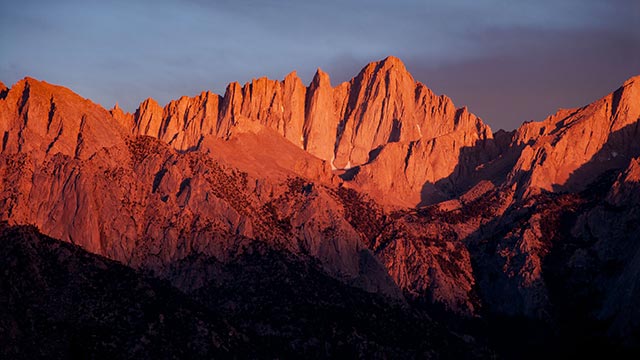
Mount Whitney — the Mountaineer’s Route
Saturday, June 30th, 2007

Mount Whitney - Mountaineer's Route

I’d hoped to ski the Mountaineer’s Route this year, but the South Sierra winter did not cooperate—as many of you know firsthand.

Still, it had been a while since I’d climbed Mount Whitney, so I decided to return for a summer climb. Thanks to the poor snowfall of winter and spring, the Mountaineer’s Route is currently as snow-free as I’ve ever seen it.

That significantly reduces the route’s challenges, making for a (relatively) easier, safer climb—particularly on Whitney’s north face. If you are considering climbing the Mountaineer’s Route, I heartily recommend it. The route is spectacular. Be aware, however, that hiking conditions are currently unusually favorable on the mountain. Under more normal circumstances, the Mountaineer’s Route can well be a technical endeavor requiring ice axe and crampons, and the skills to use both safely.

Trip Report: Mount Whitney via the Mountaineer’s Route

Lincoln Hall Survives Everest

Tuesday, May 30th, 2006

It has become another ‘bad’ season on Everest—fifteen climbers dead so far, including skier Tomas Olsson, who was skiing the mountain’s north face.

And then this: following a successful summit bid, climber Lincoln Hall collapsed around 8800 meters, struck by cerebral edema, one of the deadliest of the many high-altitude disorders.

Sherpas tried for nine hours to get him off the upper mountain, but eventually gave up for their own safety. Hall was left on the mountain, and word was sent to his family and to his native Australia that he had perished.

Seven a.m. the next morning: climbers on the way to Everest’s summit found Hall alive. His first words were reportedly, “I imagine you are surprised to see me here.”

Miraculously, Hall had survived a night alone on Everest. With the aid of fresh sherpas, he was assisted down the mountain to base camp, where, aside from frostbite, he quickly recovered.

It is strange, isn’t it, to read these stories? Every year, Everest’s call lures climbers to the deaths, and still they come.

If the opportunity came for you to go to Everest, would you be able to resist? Would you go, but tell yourself (as writer John Krakauer did) you’re only going to climb a little way above base camp? Or would you take your best shot, come what may?

» Back to Home

SierraDescents Features