Archive for the ‘video’ Category

Split Mountain – South Face

Friday, June 11th, 2010

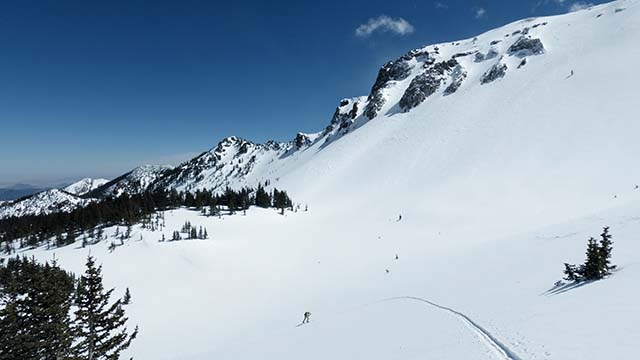
Originally our objective was a fiercely ambitious loop in the Williamson arena, but conditions didn’t look favorable, or maybe we just weren’t stoked about putting in that much work, so we kept driving north. Farther up Highway 395, Split Mountain’s south face looked enticing, so we gave it a go.

Without having scouted the area beforehand at home, I wasn’t terribly confident I could stay on-route in the dark, so I got a relatively late 4 a.m. start. That proved to be about an hour too late. The California sun turned Split’s upper south face into one big slush field by the time I got around 13K feet. Post-holing down to my thighs and starting to wheeze to the point of having trouble breathing, I decided the prudent course of action was to turn back. I do like to try to be reasonable at least once in a while.

My partner Dave of course was on his usual blazing place, and topped out on the South Summit right about the time I decided to quit climbing. By coincidence, we ran into Howie Schwartz of Sierra Mountain Guides, who was playing hooky from his guiding duties and off having a little fun by himself. SMG, you may recall, was the company I chose to guide my climb of North Palisade, and Howie was also my teacher for the Level I Avalanche Class I took this past winter at June Mountain.

So, small world.

My impressions of Split? It is indeed a hard mountain to get to, necessitating a vehicle-bashing drive over some really ratty dirt roads. It is also one of the most strikingly beautiful peaks I’ve climbed. Check out the colors bursting out of the granite in the video. Yes, it really did look like that. The skiing was fantastic: smooth, glorious snow that just went on and on and on. The climb itself up Split from the Red Lake trailhead is a long one. I’ll be back—and I’ll definitely be budgeting a little more time for the ascent.

U-Notch Ice Dancing

Tuesday, June 1st, 2010

Here’s what I was thinking: I was nine hours deep on a ski attempt of North Palisade’s U-Notch Couloir, and all was going well until the easy snow I was climbing abruptly transitioned to ice thirty vertical feet or so below the top of the couloir. The ice was steep—probably 45° to 50°—and it definitely wasn’t skiable…but there was a patch of powdery snow immediately below, on a slightly flatter pitch, that could with some optimism be viewed as a sort of marginal safety net.

The prudent choice was to stop right there and ski down. Instead, I decided to keep climbing and try to manage the ice on skis. Watching this clip, from the comfort and safety of my home, I’m not exactly sure what to make of that decision. I knew there was a good chance my edges would break loose, but I also knew there was a good chance I’d be able to stop once I hit the powder pillow below.

So, it’s possible to look at this and say everything went exactly according to plan.

On the other hand, when I did break loose, the speed and violence of it was terrifying. At a 45 degree angle, on ice, your acceleration is basically equivalent to free fall. Additionally, when I started sliding my angular momentum caused my body to rotate so that my ski tails were pointing downward. This complication, as you might imagine, was not something I had anticipated.

Probably this video clip ought to go straight into the vault and never see the light of day. But it’s fair, for those of us who practice the art (or madness) of high-angle skiing, to be reminded now and then just how close the edge is when you’re standing on skis, on a steep slope, deep in the heart of an icy wilderness.

The Couloir to Nowhere

Sunday, May 23rd, 2010

I had a dream: I wanted to create a website to share my California hiking and skiing adventures. Problem was, digital cameras were primitive and expensive. Consumer video cams shot fuzzy SD footage on analog tape (which was incredibly expensive to edit). And I didn’t know the first thing about starting a website. Still, it just seemed like such a natural extension of my interests in the outdoors, writing, and photography: bring the backcountry to the binary realm, so that people all across the world could experience it.

How things have changed! Technology today makes it possible for me to bring you my first film, shot entirely in HD, edited at home in my living room, and distributed worldwide, instantly. It was obvious, looking over the raw footage from our Iron Mountain adventure, that the material deserved more than just a cursory edit. As I became immersed in the project, I was inspired to try to retell the story of hiking and skiing this amazing (and amazingly-remote) mountain, located a mere 35 miles from downtown Los Angeles.

To help bring the film to life, my son and I recorded four songs: a classical piece I like by Manual Ponce from his Suite in A, as well as three variations of an original theme (loosely inspired by Ennio Morricone’s work on The Good, the Bad, and the Ugly) which we’re calling “The Men of Iron.” That we ended up with such fertile raw video footage is due in large part to the work of David Braun, who proved to be an amazingly disciplined second cameraman, ensuring we captured the complete top-to-bottom ski descent. This project, on many levels, wouldn’t have happened without him. Credit is also due to Lou Bartlett, who joined us for the hike, shot a few clips himself, and helped keep me moving upward when my body and spirit began to sag.

And finally, thank you to all of you who visit this site, write in, say hi in the backcountry, or otherwise inspire me to keep it going. Southern California has a vibrant backcountry skiing and mountaineering community, and I’m proud to be a part of it. One last note: I am going to get a run a professionally printed DVD’s (and BluRay if I can afford it) put together. If you would be interested in getting a copy for maybe $10 or so, please email me so I can estimate how many to make. Enjoy the Video!

San Gorgonio Mountain

Sunday, May 2nd, 2010

I’m going to have to make the drive out to the San Bernardino Mountains more often! Al and I skied San Gorgonio Mountain yesterday, and aside from a little wind up top, we were treated to a positively gorgeous day of Southern California backcountry skiing. In terms of snow quality, this was probably one of the best days I’ve had in the local mountains. The summit ridge was predictably bulletproof, but things softened nicely as we descended, and the lower gullies were nothing less than perfection. A long day, but definitely worth it.

We hiked in from the South Fork Trailhead on Highway 38, and ultimately ascended and descended San Gorgonio from the summit via the north/northwest face. I should also mention that we crossed the path of a recent (2 months ago?) large, destructive avalanche, which knocked down a huge swath of trees along the South Fork trail in an area where few people would have assumed there was any risk. Makes me glad I’m a Spring mountaineer. Enjoy the video!

Telluride: Top To Bottom

Monday, March 1st, 2010

I’d been thinking about getting this shot ever since I first bought my ContourHD helmet cam: a continous clip skiing Telluride from the top of the Revelation chairlift, elevation 12,570′, all the way down to the Gondola station in the Town of Telluride, elevation 8,750′. Getting the shot proved trickier than expected, thanks to the weather and the many quirks of the ContourHD cam, but I love the result.

This is probably my favorite in-bounds ski run on the planet. Sure, there’s a bit of catwalk travel on the upper parts of See Forever until you pass Chair 9, but the flat sections just contribute to the run’s appeal, as they allow you to better enjoy the views of the spectacular San Juan mountains. And there are plenty of steep, groomed sections to let the boards run—culminating in the warp-speed fun of Milk Run or Coonskin. Finally, if I’m skiing this run, it means I’m in Telluride, which is always a good thing. 3800 vertical feet in a relaxing nine minutes. Enjoy!

A Powdery Plunge

Sunday, February 21st, 2010

Lots of fresh snow here in Telluride, Colorado, where I’m taking a little lift-served vacation. Video is helmet cam footage from the ContourHD 1080p. I upgraded from the 720p ContourHD to check out the new model. Interestingly, after a week of testing the camera, I decided I like the 720p better. There’s just too much shutter roll in the 1080p mode (you can see that here as distortion in the treetops whenever I hit a bump). Additionally, the 1080 mode uses a narrower view angle, which increases the effects of camera shake. I’ll get a full review of the 1080p ContourHD up in the next week or so.

San Antonio Ridge Traverse

Tuesday, February 16th, 2010

Ah, where to begin? In the immortal words of Tech and Talk’s Chad, ‘A bad snake charmer always blames his snake.’ So I guess I can’t blame the snake. I knew, going in, that a ski traverse linking Mount Baldy and Iron Mountain via San Antonio Ridge was definitely pushing the limits. But still, something about staying close to home always makes me more inclined to be ambitious (more…)

Telegraph Peak: North Face

Monday, February 1st, 2010

The Problem with Telegraph Peak is that it’s way too easy to access. The typical San Gabriel Mountain approach serves as a fine gatekeeper to most of the range’s technical adventures, but not so with Telegraph. This little shark tooth of a peak sits just beyond the rope of a popular (if quirky) Southern California ski area, and when there’s snow on it you can practically hear the siren song calling.

Among the considerable hazards Telegraph offers, rockfall is one of the more prominent. The north face is a shooting gallery of rocks of all sizes. Even here, only a few days after fresh snow, the apron beneath the north chutes is already coated in rocks and shards. Telegraph Peak is also very steep, likely in the 45° range, and like many aspects in the San Gabriels, the snow can be exceedingly icy. A fall would be consequential.

Avalanches of all types are a threat here as well—in fact, the gully below the north face is a classic terrain trap threatened by virtually 360 degrees of slope aspects. Just to mention one more potential hazard (this list is by no means exhaustive), when you ski Telegraph Peak you must climb back up to return to the safety of the ski area, and this climb is sure to test your resolve (as well as your preparedness). For more on that subject (and the cruel, cruel topography), see my trip report into the neighboring Stockton Flats area.

Giving Vimeo a try here for the video hosting. Looks like the quality might be a little higher. If you play the video in HD, be sure to expand to full screen.

Jean Peak: East Face (Video)

Monday, January 25th, 2010

Driving across the L.A. Basin on Saturday was like being transported to a new and wintery world. Snow levels were down around the 3000′ mark across Southern California, putting snow atop nearly all the foothill ranges, and coating the major ranges in vast sheets of gleaming white. I confess I actually felt a bit of anxiety looking at it—so many things to ski, so little time. Routes that are almost never viable are currently in fantastic shape.

To be extra safe, my partner Bill and I decided to take the tram up and ski Jean Peak, in the San Jacinto Mountains. Jean offers moderate slopes in abundance, perfect for making turns on potentially-unstable slopes. To put my new skills into use, I did dig a snow pit, and I ran some compression tests. The results were a bit of a surprise. The snow, as expected, was very dense and water-laden, with a nice graduation of lighter to heavier as I dug deeper. But I didn’t expect to find a clean shear around 14″ down. Reactivity was pretty much nill, but still, somewhere in the snowpack (at least on Saturday) there was a clearly unstable layer. It definitely made me feel better about choosing conservative terrain, post-Mega Storm.

The video shows the climb up and ski down. Our late start put us on the summit of Jean only about an hour before sunset, making for great photography. Views really were jaw-dropping. This might have been the most beautiful day skiing I’ve ever enjoyed in SoCal. And the snow was wicked good: dense but completely uncrusted powder. Float, float, float—I can still feel it beneath my toes. :) Shot in HD: for the full effect, switch to 720p, hit pause to let it buffer, then be sure to watch in full-screen. Enjoy!

At the Snowbowl

Monday, December 28th, 2009

Back home in California now and watching these upcoming storms to see what develops. Here’s video of my day skiing the Arizona Snowbowl in Flagstaff, Arizona—the mountain, for all practical purposes, where I grew up and learned to ski. I still love skiing the Snowbowl, and conditions were excellent, if a bit chilly. The day started out around six degrees F.

This video probably isn’t exactly scintillating, I know, but I’m continuing to play around with my two HD cams and trying to figure out how to cut together good ski footage. So, these are kind of little training flicks for me. At some point I’ll probably do reviews of all the video gear I’m using, including my much hated but also indefensible indispensable Sony Vegas software. This time I was skiing with my Canon Vixia HF200. Image quality remains stunning with the 1080i Vixia, though it unfortunately only records interlaced video, which means we lose resolution when we create a progressive mp4 for the internet (this clip is mixed down to 720p).

The blue-jacketed skier is my brother, employing his typical bullish form. Red jacket is my dad. I asked him to get some shots of me skiing, but he ended up filming the sky for five minutes. Just a reminder that it’s always a good idea to befriend a photographer. :)

As you see above, I was actually doing some hand-held shots to emulate helmet cam footage. This was of mixed success. Following my dad and snowplowing slowly, for example, you can see that I’m doing a reasonably good job of getting a stable image. But as soon as I point the boards downhill and start turning, the picture jumps around. Exposure all in all is pretty good here. I am using Vegas to tweak the levels in real time, which is a slow process, but that way the snow stays white rather than gray when it dominates the frame. I may try setting a fixed exposure next time to see if I can get away with that approach. Anyhow, comments are welcome on all this.

» Back to Home

SierraDescents Features