Archive for the ‘Climbing’ Category

Slings ‘n Physics

Tuesday, July 13th, 2010

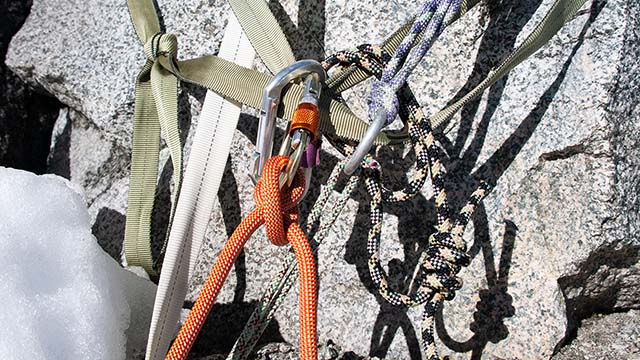
If climbing’s your bag you might want to check out this sling drop-test video by DMM, in which they conduct a head-to-head comparison of Dynema and nylon slings in Factor 1 and 2 falls. The test is intended to replicate a scenario in which a climber, at a belay station, clips directly to an anchor using a short sling and then falls (more…)

This is Your Brain on Altitude

Friday, November 6th, 2009

The New Yorker recently ran a disturbing article on brain injuries in football. Just about the same time, Outside magazine wrote about an alarming study of the effects of moderately-high altitude on climbers’ brains.

It has been known for some time that Everest climbers often show symptoms such as memory loss and poor coordination when they get home. And studies have found irregularities in the brain scans of 8000-meter climbers. The presumption has always been, however, that these effects lie exclusively within the domain of high altitude climbing (roughly defined as involving elevations of 22,000 feet or higher). The Outside article makes it clear this presumption may be dead wrong (more…)

Mt. Whitney’s East Face

Thursday, August 27th, 2009
Mount Whitney's East Face

Mt. Whitney’s East Face

When I close my eyes I see granite.

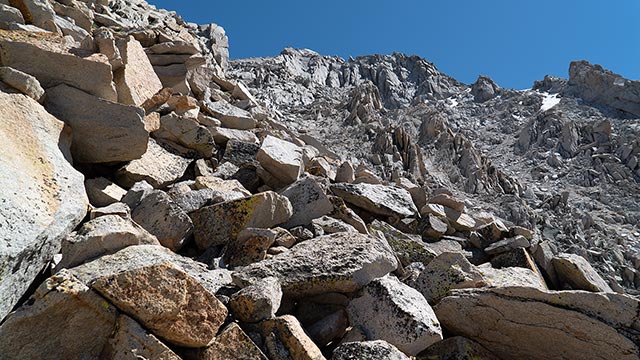
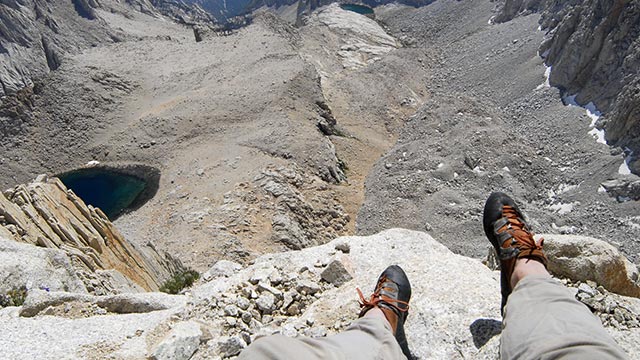
Gray-white blocks angle sharply beneath my feet, plunging downward past my rubber-tipped toes. I press my back against a wall of rock as if I could somehow dissolve myself into the mountain.

Everything feels like it’s moving—the rock, the ground, the air—all conspiring together, pushing me toward that void…(read more)

The Fresh Air Traverse

Sunday, August 16th, 2009

→ info & HD instructions:

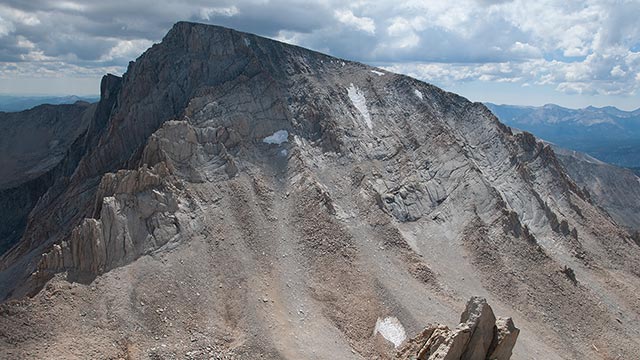
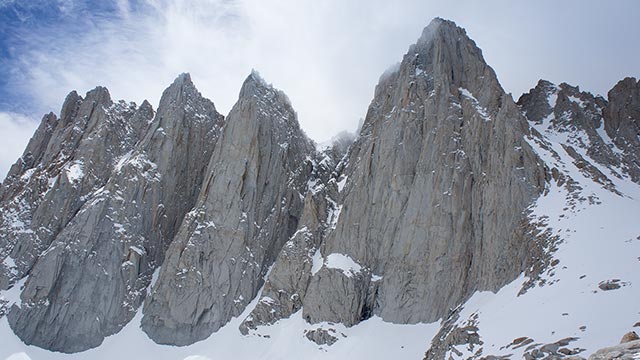
Mount Whitney’s East Face is perhaps the classic Alpine climbing route in the Sierra, featuring an otherworldly mix of moderate climbing and breathtaking exposure. I had wanted to climb the East Face from the moment I first summited Whitney—but at the time it seemed like a dream that would permanently remain unfulfilled. Last weekend, I got the chance to give it a try with help from Kurt Wedberg of Sierra Mountaineering International. The experience was extraordinary. For the full report see: climbing Whitney’s East Face.

This also happens to be the first trip where I carried an HD video camera (actually two), so I’m working on a bottom-to-top video of the climb. While you’re waiting for that, here’s a taste of one of the climb’s most famous segments…the ‘Fresh Air’ Traverse.

Some notes on HD: unless your connection speed is very speedy, you’ll likely want to let the video buffer fully before watching. Click the play arrow on the player toolbar, then the “HD” button (which then appears), then immediately hit the pause button. Go have a cup of coffee and let the video load (10-15 mins), then hit play and finally click the rectangle button to expand the view to full-screen. The video should now play smoothly from start to finish.

As you may be guessing, switching from SD to HD video has proven to be a total trip down the rabbit hole. Basically every downstream software/device/system I owned had to be replaced to cope with the file size, plus there’s literally a graduate degree’s worth of standards and compatibility info to learn. So, I’m beat and my operating budget for the rest of the year has been annihilated. But it’s hard to argue with the end result. :)

Off to Whitney…

Friday, August 7th, 2009

Off to Whitney to try to redo a climb that got canceled last June when a surprise snowstorm blew in over the Sierra. This time looks like a go. I’ll be carrying a record number of cameras for the trip, including two HD video cams (three if you count my new D5000), so I hope to be able to put together the most media-rich trip report ever when I get back. If all goes well. :) No updates ’till next week, so have a great weekend.

Whitney Fatality

Wednesday, April 29th, 2009

A female climber was killed Saturday night or early Sunday morning while descending the Mountaineer’s Route with a group of several others on Mount Whitney. At this time there seems to be an almost total lack of confirmed information about the incident.

Sketchy reports from persons in the area were briefly available on the Whitney Portal Store message board. Unfortunately, due to the forum owner’s policy regarding fatal accidents, that thread has been deleted. There is also this.

From what I’ve heard, the party may have planned to watch the sunset atop Whitney and then descend back to Iceberg Lake. Or perhaps they planned to spend the night atop the summit, but changed their minds due to unfavorable conditions—it was an extremely cold night in the Sierra. I happened to be several miles north, climbing through the night toward Shepherd Pass at the time. It was very cold and windy.

Regardless, the snow at that elevation would have quickly frozen into ice after sundown, turning a challenging snowbound route into a technical ice climb. I myself would go to great lengths to avoid downclimbing in conditions like that without a rope and excellent anchors.

I can’t help but wonder whether the group’s experience level was of such a high caliber that they felt confident they could safely descend the icy chute in the dark. Or did they feel they had no other options? It is possible, given the large numbers of inexperienced climbers who attempt Whitney each year, that they were simply unaware of the extreme hazard they were exposing themselves to.

Deaths on Mount Whitney are unfortunately not entirely rare, particularly in the Winter and early Spring climbing seasons, particularly while climbers are descending either the Mountaineer’s Route’s upper chutes or the steep snowfield above Trail Camp. Whitney in Winter is a technical endeavor, requiring specialized skills and gear for safe travel, and subject to unpredictable weather and conditions.

If more substantiated information becomes available, I’ll post links here.

Idiot’s Guide to Lone Pine Peak

Tuesday, March 24th, 2009

Well, with a title like this, how can you resist? If I’m reading this correctly, these guys were attempting a winter ascent of Lone Pine Peak’s Northeast Ridge—a Big Route, by any standard.

The interesting thing is that nowadays with forums and digital cameras, you get to read first person accounts not just when people successfully summit, but also when things go awry and SAR is called. Also don’t miss this: a bonus Trip Report addendum posted by the climber’s girlfriend.

Axes, Crampons, and Ice Cliffs

Thursday, October 16th, 2008

I was reading Andrew McLean’s latest article in Backcountry Magazine, in which he hawks the advantages of using Black Diamond Whippets instead of an ice axe for ski mountaineering.

Noting an axe and crampons can allow you to climb nearly anything, McLean makes the interesting observation that Whippets can serve as a Voice-of-Reason for overly ambitious ski mountaineers:

If it’s too hard to climb with Whippets, says Andrew, maybe you should come back with a rope. Or ski something else that day.

Reading that made me immediately recall my first-ever experience climbing with an axe and crampons, which happened to be solo on Core Ridge’s north face in the San Francisco Peaks’ Inner Basin. Did I get in over my head that day? You betcha! Amusingly enough, I wrote about the experience for SierraDescents, but that feature got lost when I migrated to the new Word Press system, so I’ve reincarnated it here: (more…)

LA Climber Among K2 Survivors

Tuesday, August 5th, 2008

On August 1, 2008, Hermosa Beach climber Nicholas Rice awoke after a freezing night at Camp IV and made his way to just below the “Bottleneck”.

Rice, 23, was attempting to climb K2, the world’s second-highest mountain, widely considered one of the world’s most difficult summit (and one of the most deadly).

The Bottleneck, as the name implies, was an exposed section of the climbing route where climbers were dependent on fixed ropes set by other climbers and Sherpas for passage up and down. In this way, the Bottleneck is similar to Mount Everest’s Hillary Step. Unlike the Hilary Step, however, the Bottleneck lay beneath a system of ice seracs—towering and unstable blocks of ice.

That morning at camp, Nick had spilled water on his socks, getting them wet. Consequently he got a late start that day. After about an hour of climbing, Nick (who was climbing without oxygen) still wasn’t warming up. He decided the prudent course of action was to turn back, and he did so, returning to Camp IV. After resting at camp for several hours, Nick decided to continue descending. Other climbers continued upward.

Soon after that, Nick learned that the ice blocks overhanging the Bottleneck had broken loose in an avalanche, killing three climbers and stranding others above by destroying the fixed ropes.

Like the events described in John Krakauer’s book Into Thin Air, the K2 avalanche has a ghoulish quality that lingers in the imagination. Discovering that the ropes—their lifeline—had been cut, the trapped climbers’ options were extremely limited. I expect we’ll see a great deal of coverage on this tragedy as more details emerge.

Nick has posted regular dispatches of his climb, including the avalanche and rescue efforts, on his website.

EXUM Guide Dies While Soloing

Tuesday, July 22nd, 2008

The SierraJournal (formerly Sierra-Alpinist.com) has a short write-up on the death of Exum Mountain Guides employee George Gardner, 58, who died Saturday, July 19, while free soloing the Grand Teton’s Lower Exum Ridge.

One quote in particular about the story caught my attention (from the Star Valley Independent):

According to investigators, it is not unusual for professional guides—either in pairs or solo—to go out for additional climbing on their own, once their clients have settled in for the night.

Really?

Are the investigators referring specifically to EMG policy, or is this considered common practice throughout the guiding community?

The article gives the impression that it was typical for guides to leave their clients alone in order to go climb technical routes (sometimes solo) at night. This may just be a case of sloppy reporting (perhaps guides in groups occasionally split up, some staying behind with clients, some going off on their own), but if there is any grain of truth to the claim, it sure seems like a terribly ill-advised practice.

I think I’ll try a little follow-up of my own on this one.

What do you think? Is it ever acceptable for guides to leave clients behind to go off on their own and climb?

» Back to Home

SierraDescents Features